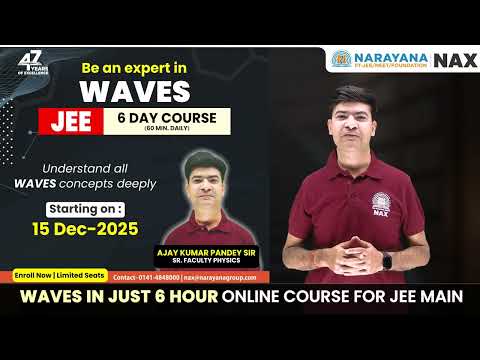
WaveX — a power-packed 6-day program to help aspirants understand all WAVES concepts deeply and master with clarity and confidence. Perfect for JEE Main aspirants seeking concept clarity, visualization, and problem-solving confidence, all wrapped into one short, focused course.
Course Description
WaveX is a 6-day JEE Main online course on WAVES!
Welcome to the Waves Online Course, a fast-paced and concept-focused program designed exclusively for JEE Main aspirants. This course covers the complete Waves syllabus in 6 interactive classes, each of 1 hour, ensuring that every essential concept is explained, practiced, and mastered within a compact and efficient schedule.
The course is structured to build your understanding from the fundamentals of wave motion to advanced ideas like resonance, beats, and Doppler effect. Every class blends theory, problem-solving, visual demonstrations, and short quizzes, helping you develop accuracy and speed—both crucial for high performance in JEE Main.
By the end of these 6 hours, you will have a strong grasp of:
Wave motion and characteristics
Mathematical representation of waves
Superposition principle, interference, beats
Standing waves in strings and air columns
Resonance and energy transfer in waves
Each class includes a daily assignment to reinforce learning, and the course concludes with a full syllabus Waves Test to evaluate your exam readiness.
Topics Covered
Fundamentals of Wave Motion
Mathematical Form & Wave Parameters
Principle of Superposition
Beats (Important & High Weightage)
Standing Waves on Strings
Standing Waves in Organ Pipes (Air Columns)
Target Learner
JEE (Main) aspirants (Class 12 & 12-pass)
This course is ideal for students who want complete, exam-oriented coverage of Waves in minimal time, with a sharp focus on JEE Main question patterns and scoring techniques.
Ajay Pandey Sir is a highly experienced Physics faculty member for NEET/JEE, with over 20 years of teaching expertise. Before dedicating himself to education, he served as a scientist at the Defence Research and Development Organisation (DRDO), where he applied the principles of physics to real-world research and innovation.